Defending Apex: hard, mostly good, and fair criticism
Notes from my MSc defence on 23 October 2026: what was hard, what went well, and what the jury was right to push on.
The value of AI assistance in software engineering is conditional on the process that surrounds it, rather than being a property of the model alone.
A process framework for using AI across the software lifecycle with people in control, and Apex, the web app that implements it.
AI coding tools have been adopted faster than any method for using them well. This thesis proposes a process framework that treats AI as a bounded, validated and traced collaborator across the whole software lifecycle, and builds Apex to show it working.
Generative Artificial Intelligence and Large Language Models have moved from autocomplete assistants to active contributors across the Software Development Life Cycle, enabling development in which practitioners express requirements in natural language and supervise the resulting artefacts. Adoption has outpaced method. A Systematic Literature Review over 646 articles confirms substantial benefits alongside recurring risks in reliability, security, traceability and accountability, and identifies the absence of structured, repeatable guidance for integrating these tools into professional workflows as the field's central unresolved problem. Therefore, value is conditional on process, not on model capability alone. This dissertation addresses that gap through the Design Science Research Methodology. It proposes a process-oriented framework for governed Human-AI collaboration treating AI systems as first-class collaborators whose contributions must be bounded, validated and traced. The framework defines lifecycle phases with phase-specific quality gates, responsibilities expressed as functions rather than job titles, and governance metrics, anchored by a persistent versioned specification linking every generated artefact to its originating requirement. It is instantiated as Apex, a web application operationalising each phase, gate and artefact against a real project management backend. Evaluation combines application in a real project, standardised usability and workload instruments, interviews with practitioners and an Agile expert, and an analytical assessment against criteria set in advance. The contribution is an evidence-grounded process model allowing organisations to adopt AI assistance without surrendering oversight of software quality, security and accountability.
84% use, 29% trust Developers using or planning to use AI tools rose to 84% (from 76%), while the share trusting the accuracy of that output fell from 40% to 29%. More respondents actively distrust AI output (46%) than trust it (33%). (Stack Overflow, 2025 Developer Survey: AI)
61% correct, 10.5% secure Benchmarked on real-world tasks, a leading coding agent produced functionally correct solutions 61% of the time, but only 10.5% of them were secure. (Zhao et al., 2025, “Is Vibe Coding Safe?” (preprint))
+98% PRs, +91% review time Across 1,255 teams, high AI adoption came with 98% more pull requests merged but 91% longer review times, and no significant correlation with delivery outcomes. (Faros AI, The AI Productivity Paradox Report 2025)
Waterfall, Scrum, Kanban and the Agile Manifesto were designed for teams in which every contributor is human. They have no explicit structure for governing AI participation, bounding the context a model may act upon, or allocating responsibility over generated artefacts.
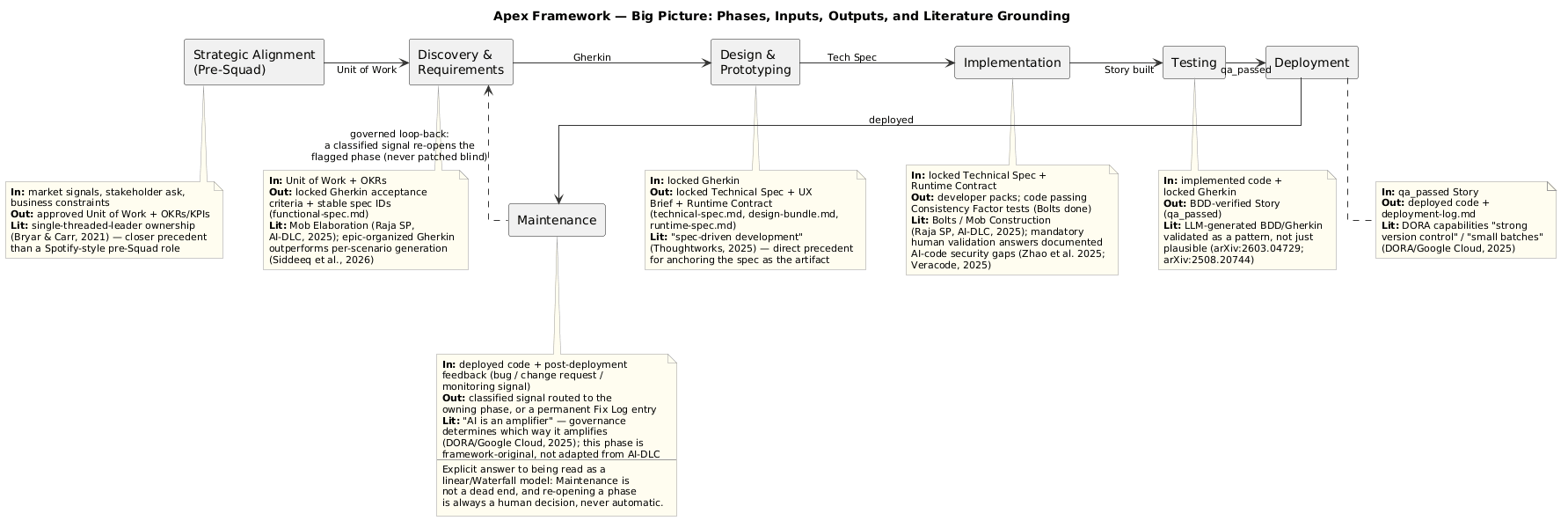
The framework is a method: phases, hats, artefacts and decision rules that prescribe how a team organises AI participation across the lifecycle. It describes process and does not depend on any tool. A Strategic Alignment stage decides whether a Unit of Work should exist at all. Six phases follow, each consuming the output of the one before and closed by a gate with a named owning hat. Failure never discards work: it returns it to a named earlier phase with the evidence attached.
Two terms recur below. A Bolt is the smallest unit of execution: the implementation of one task within a User Story. The Trio is the Product Owner, Tech Lead and Design Lead hats together, and it owns Discovery and Design.
| Phase | Role of AI | Exit control |
|---|---|---|
| P1 Discovery & Requirements | Drafts stories, compiles approved scenarios into Gherkin | Discovery Gate (the Trio) |
| P2 Design, Prototyping & Architecture | Proposes UI structure and a technical specification | Design Gate (Design Lead, Tech Lead) |
| P3 Implementation | Generates and refactors code inside a Bolt | Implementation Gate (Developer) |
| P4 Testing | Drafts end-to-end BDD scripts from locked Gherkin | Testing Gate (QA) |
| P5 Deployment | Generates the infrastructure delta only when required | Deployment Gate (Deploying hat) |
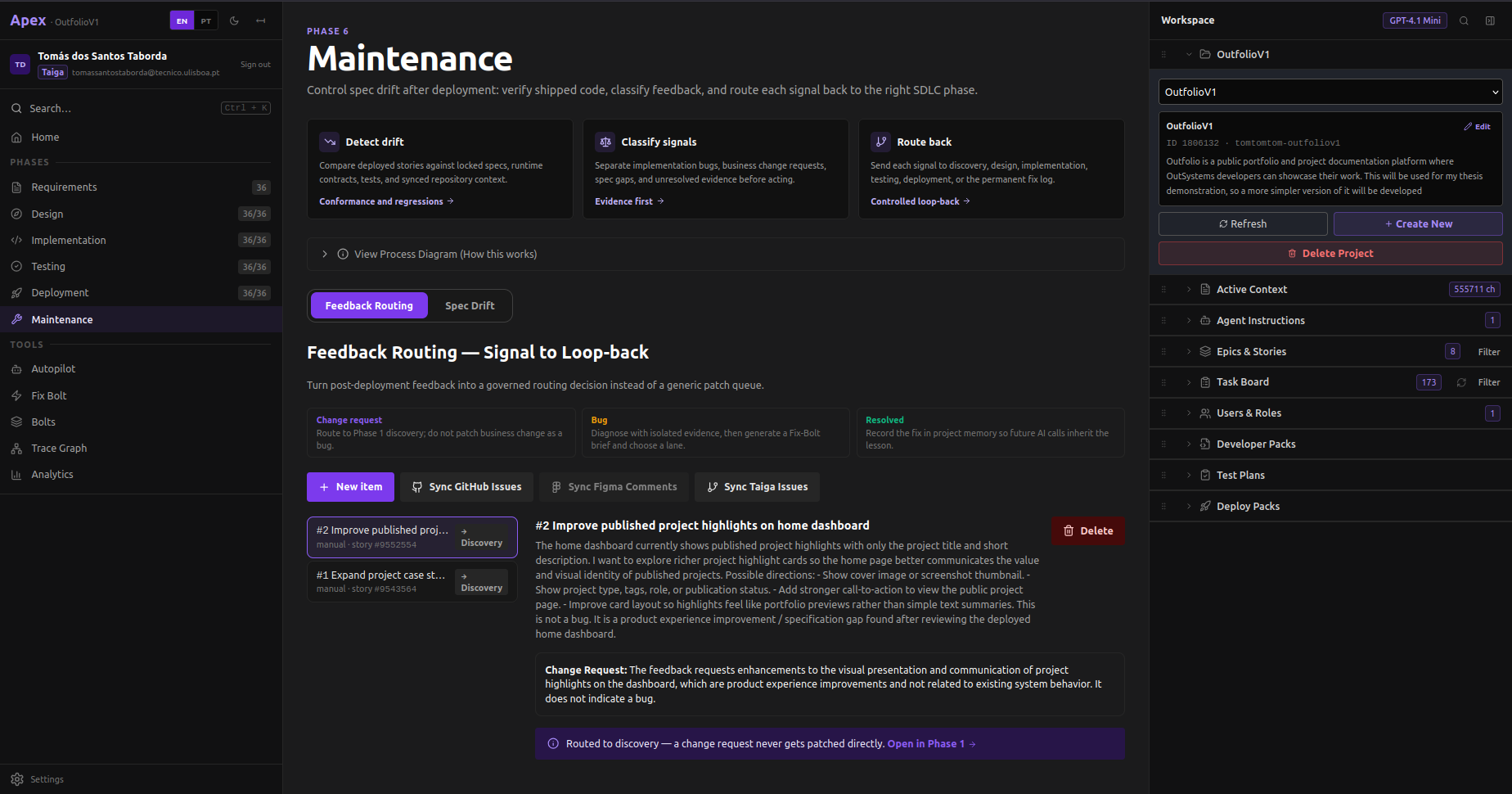
| P6 Maintenance | Reconstructs a narrow context to diagnose one signal | Diagnostic firewall, governed loop-back |
Every role is a hat: a function someone on the team has to perform. One individual may wear several; on a small team an unfilled hat falls to whoever does the adjacent work. Logistics authority (Bolt Master) is kept separate from technical authority (Tech Lead), and every gate is attached to a named function.
Every AI-generated artefact carries forward the context of previously validated phases through a persistent, versioned specification: a global layer (architecture, stack decisions, security policy) and a local layer (a story’s locked Gherkin and technical specification). Narrowing what a model can see is a control in its own right.
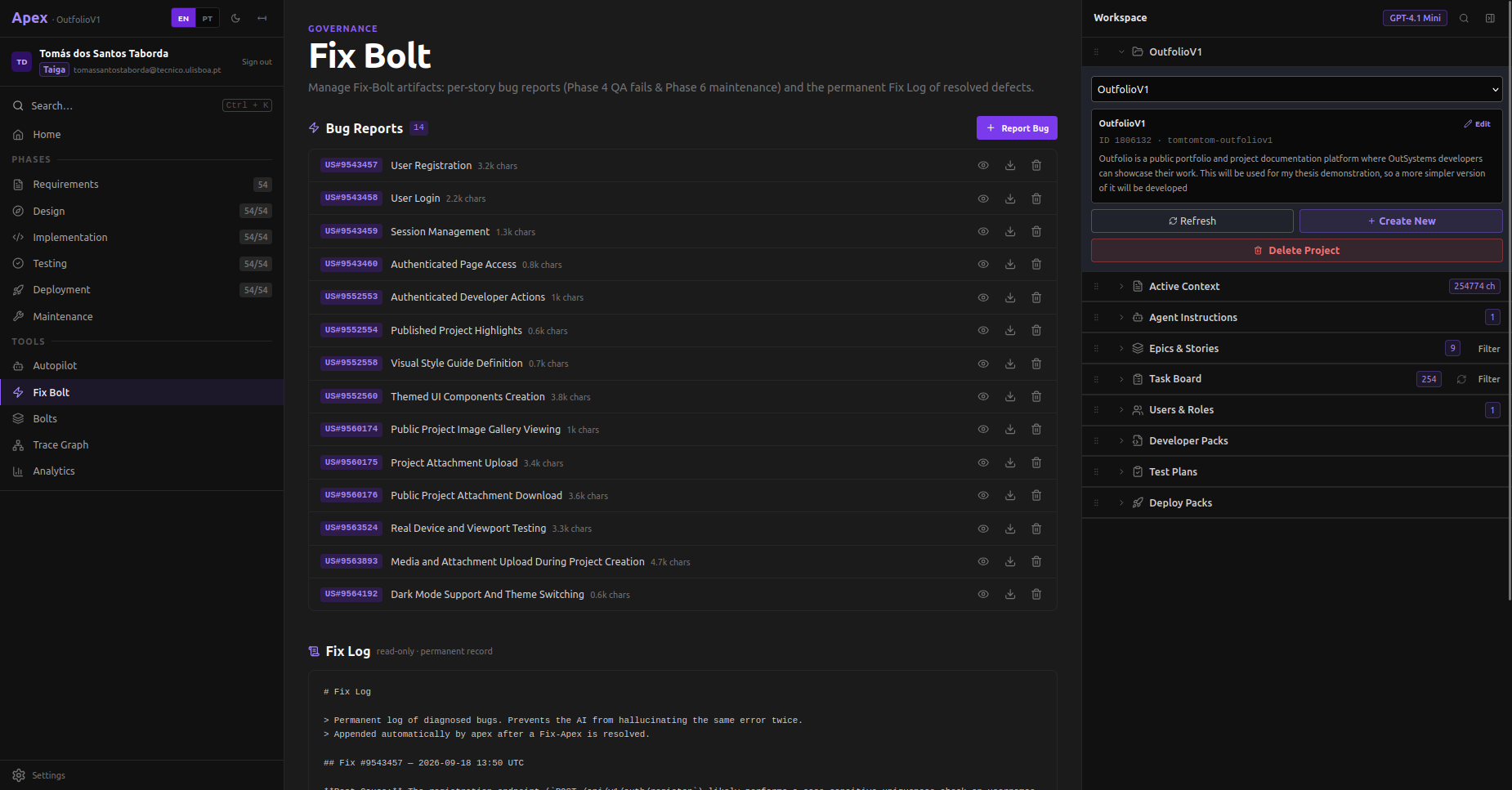
A coding agent speeds up writing code. Apex checks that the code still meets the requirement it was written for. It is a split full-stack app, a Next.js/TypeScript frontend and a Python/FastAPI backend over a typed REST API, that runs every phase, gate and artefact against a real project-management backend (Taiga or Plane) and keeps context in human-readable, versioned spec files.
Transitions are gated on content: no implementation without a locked Gherkin spec, no deploy without a QA sign-off or a green CI run, enforced server-side.
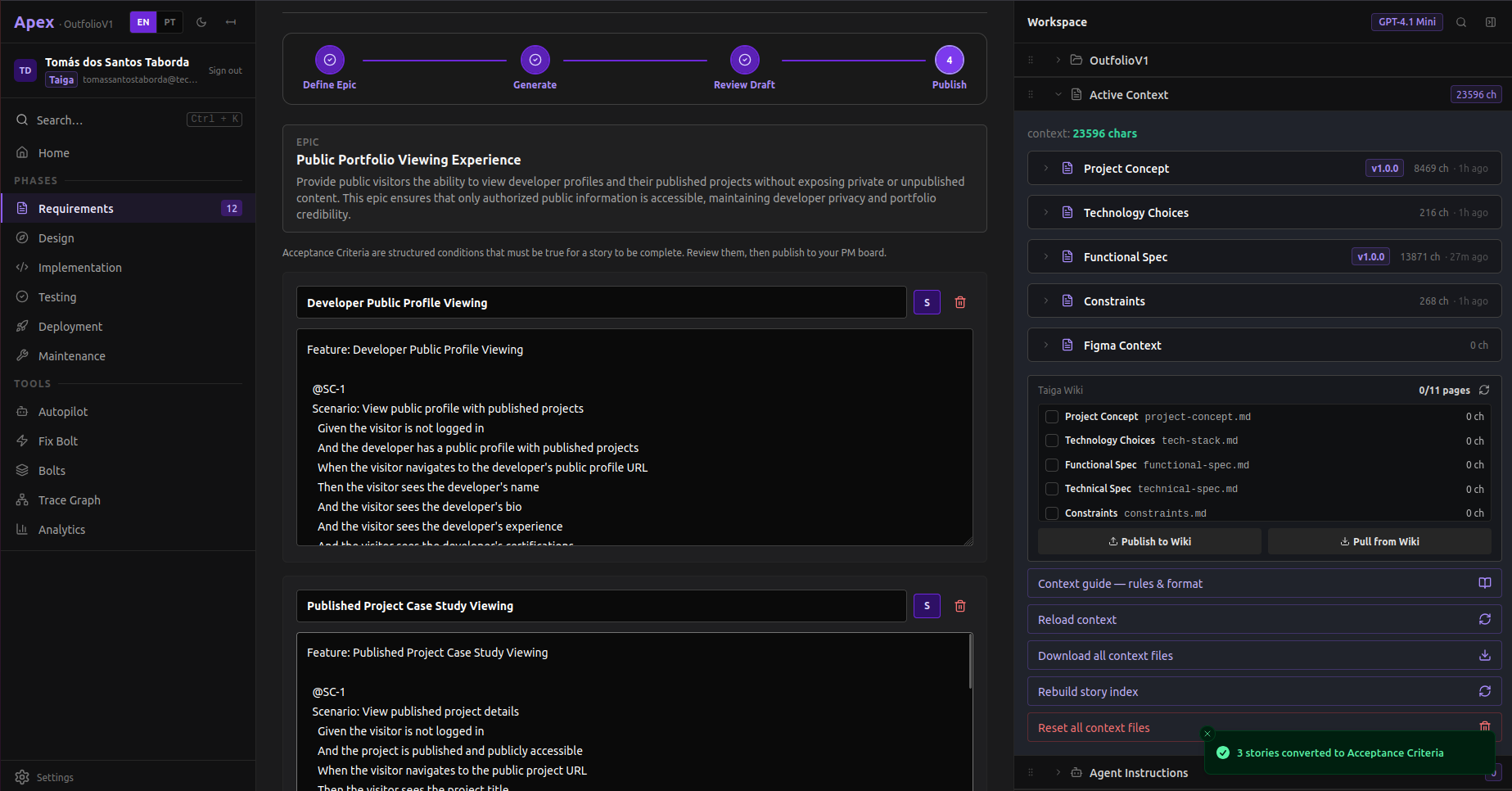
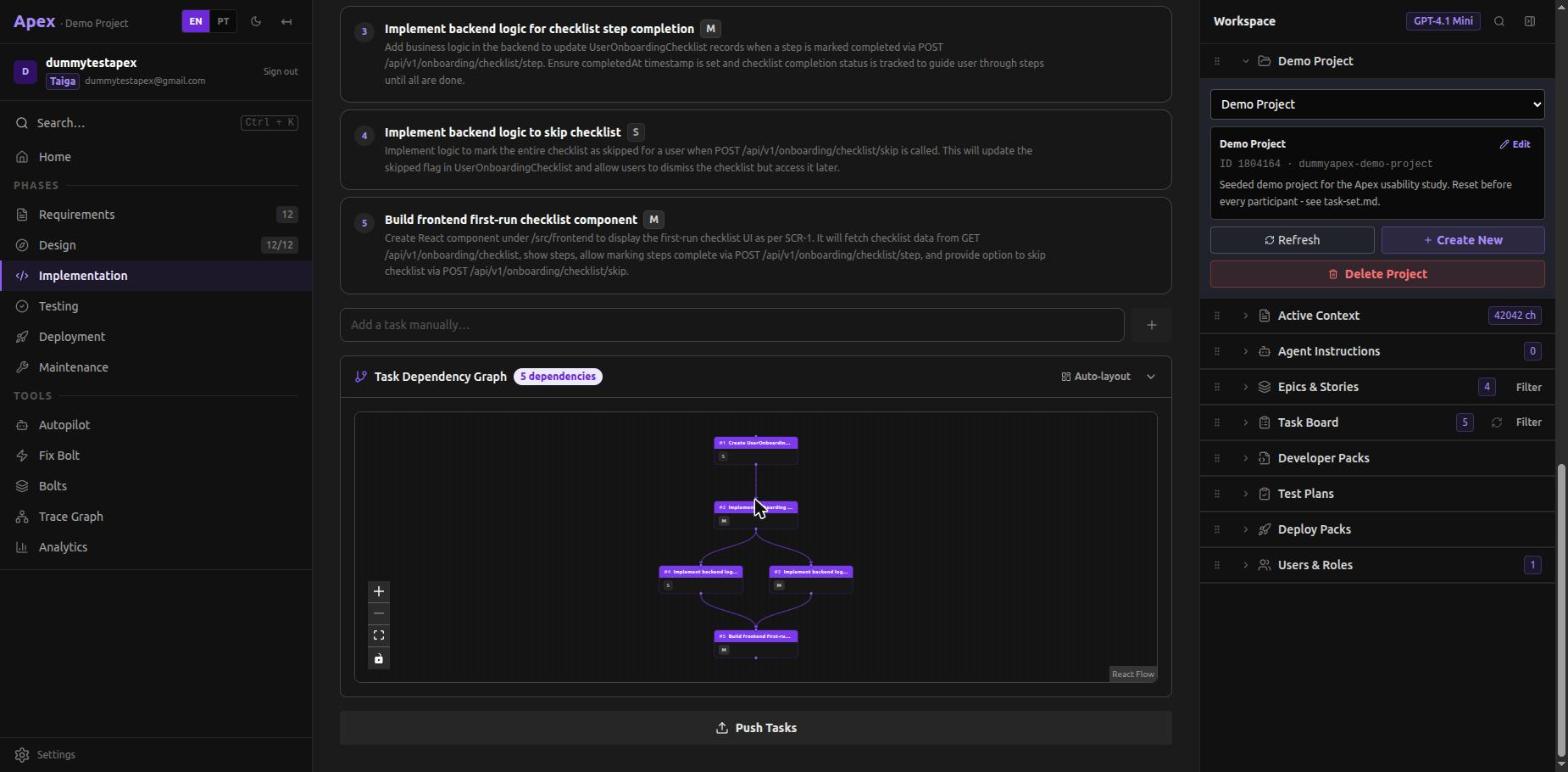
One interactive derivation graph per project (epic → story → Gherkin → design → tasks → tests → deploy), built from the story index with no AI involved.
Bolt Cycle Time, Context Traceability Rate and AI Defect Escape Rate, computed from the project and exportable as Markdown or CSV.
Multi-model cross-check, diff-on-regenerate, a decision log and an optional “Guide the AI” steer on every generative step.
Runs the full Phases 1–5 pipeline end to end in the background.
Workflow state lives in versioned, human-readable Markdown context files and a story index.
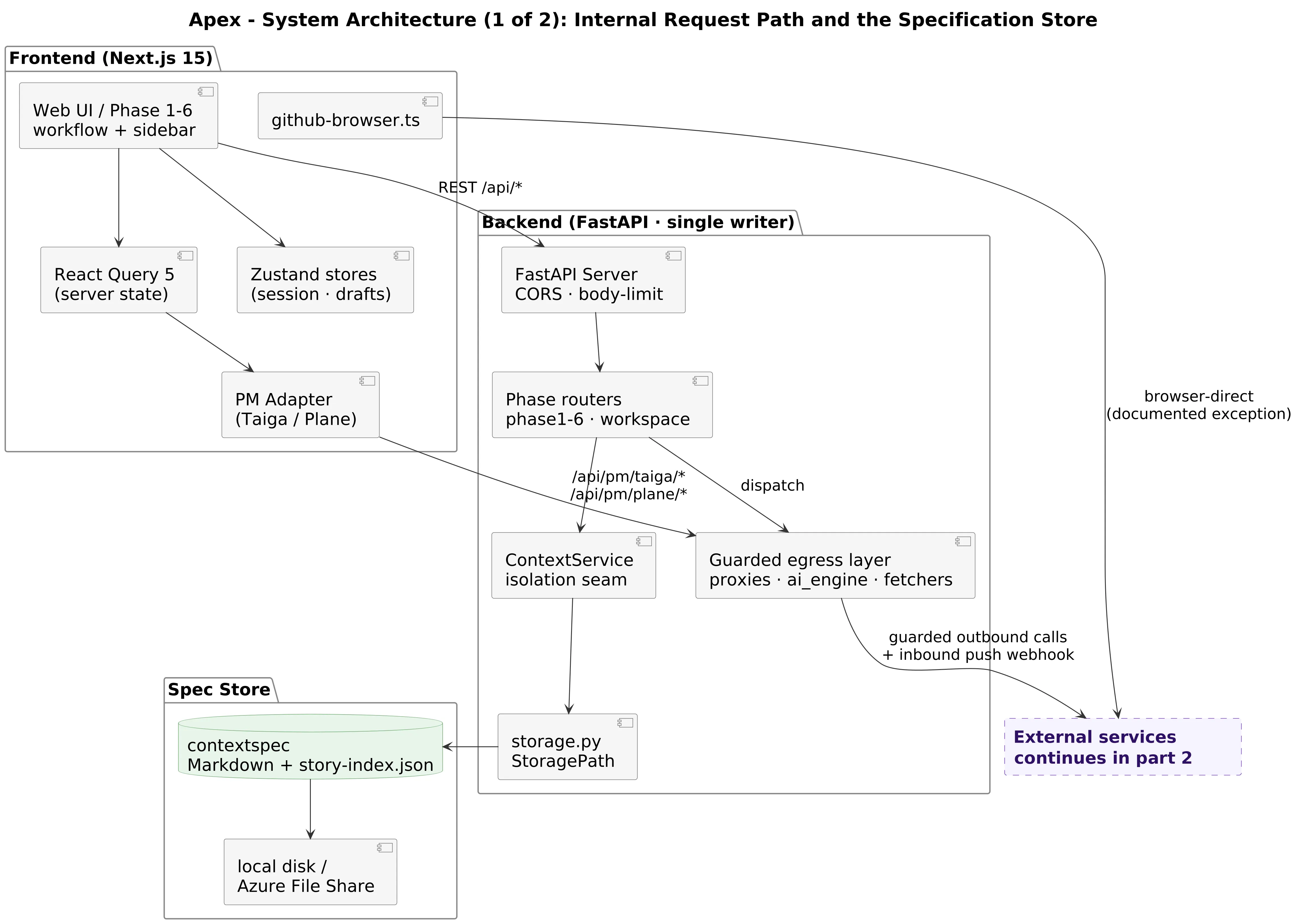
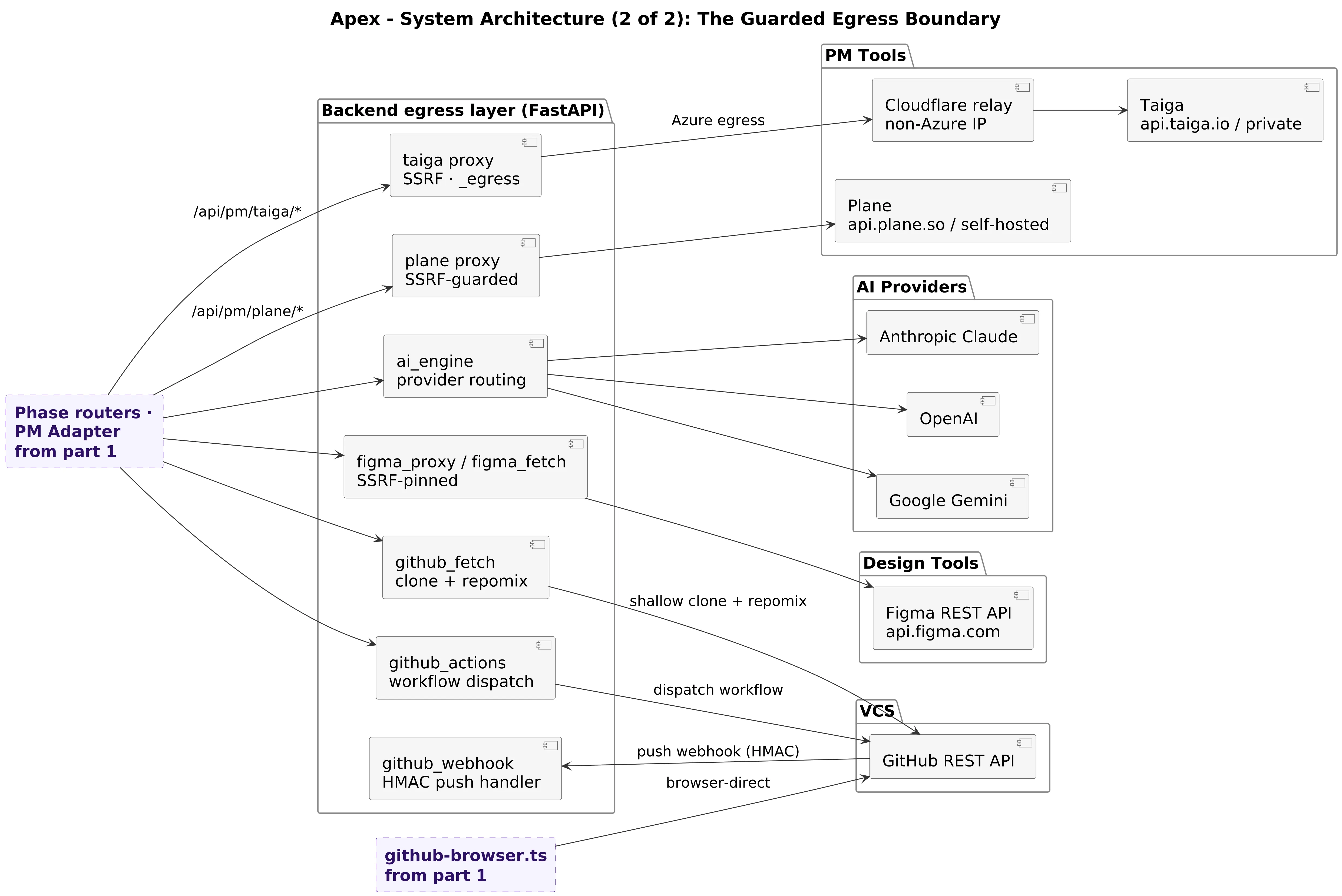
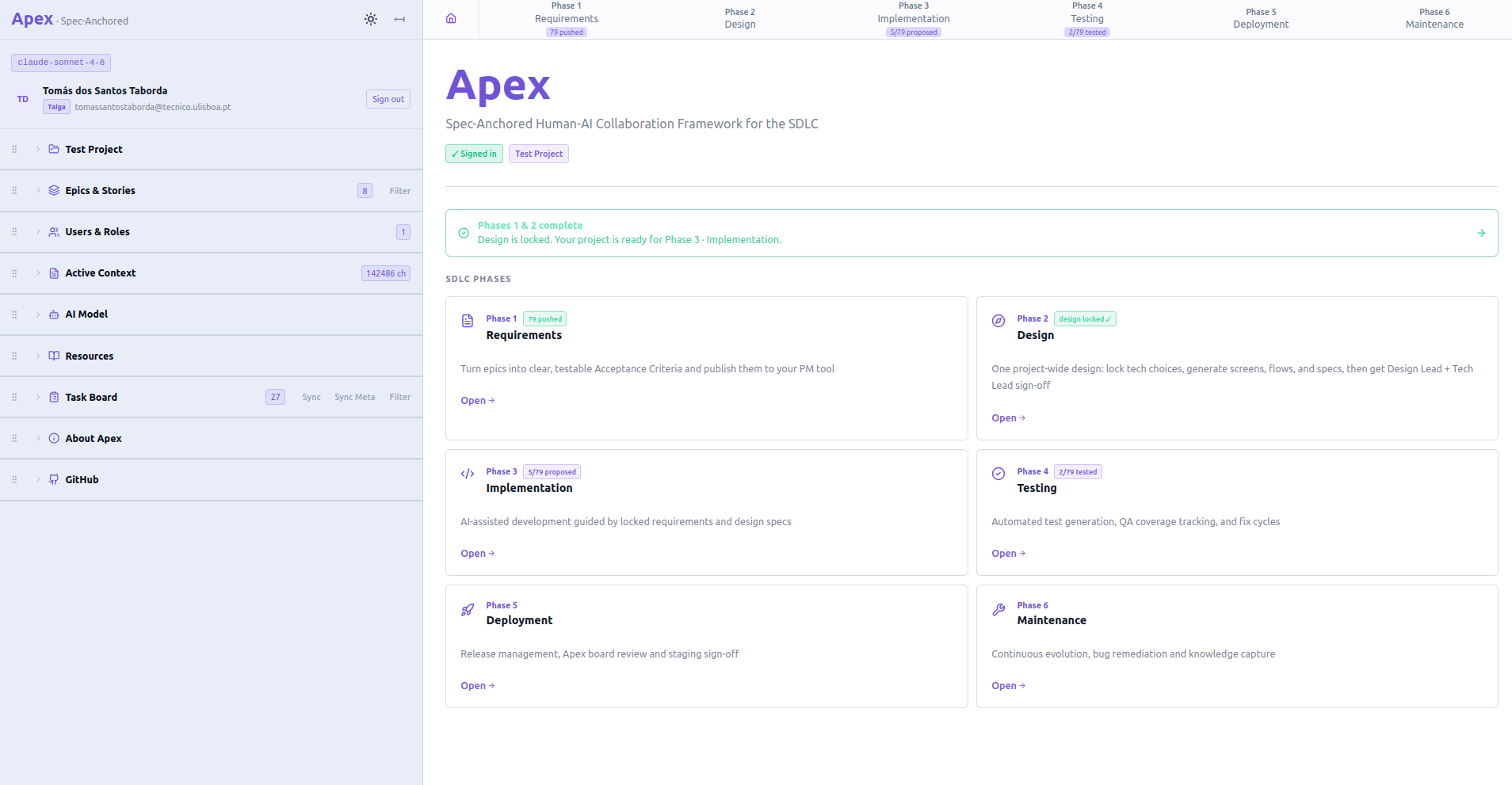
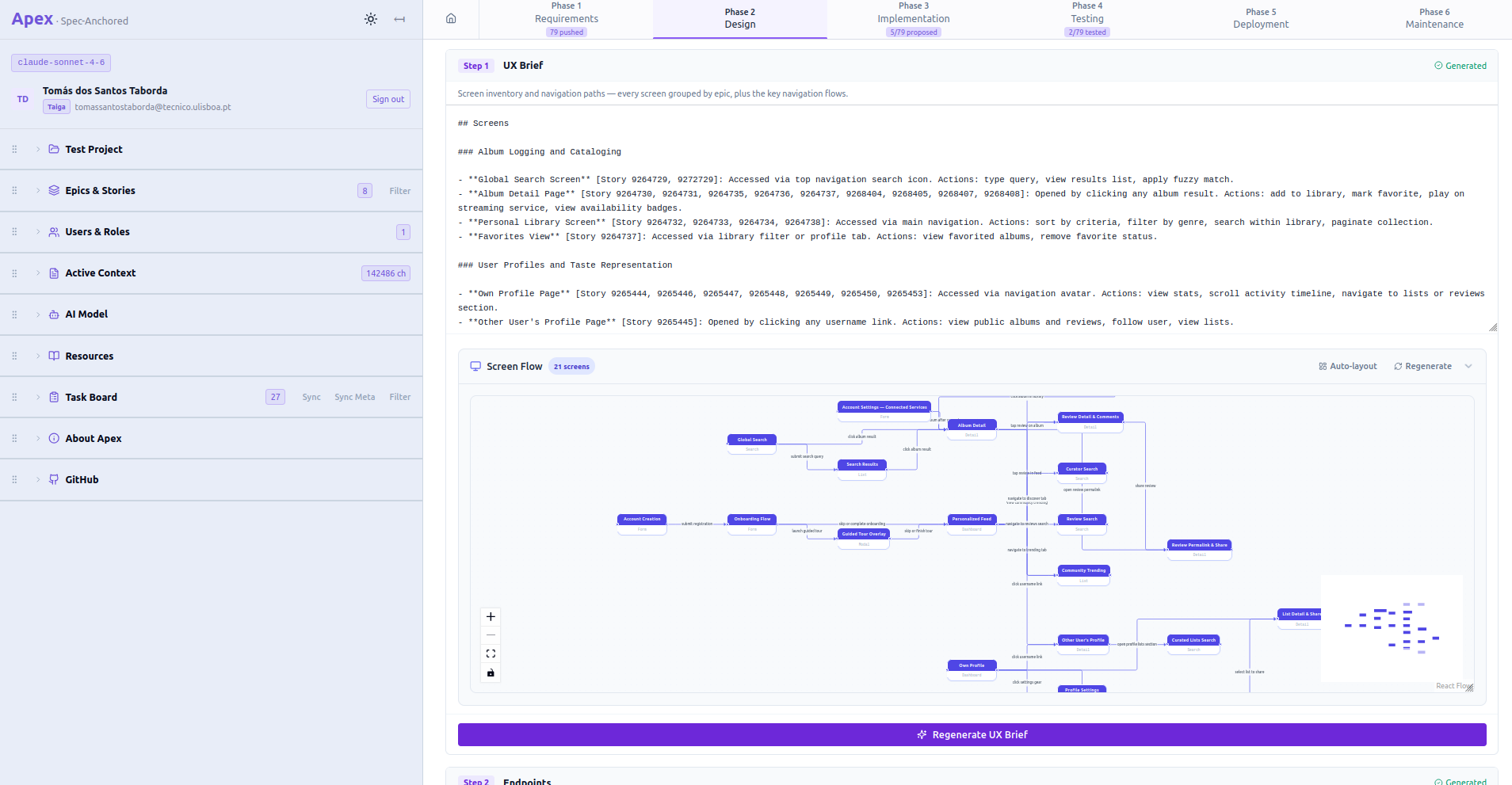
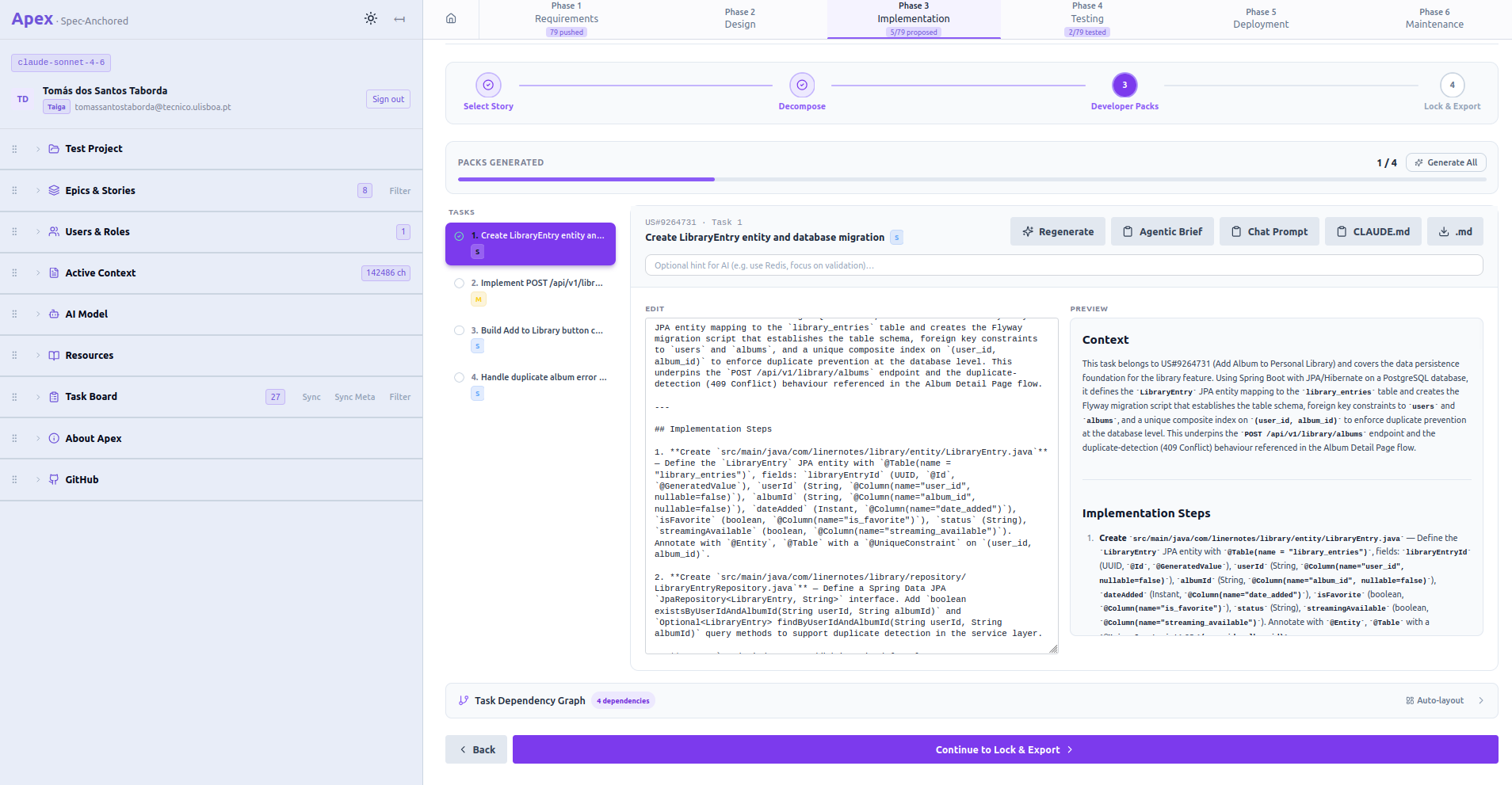
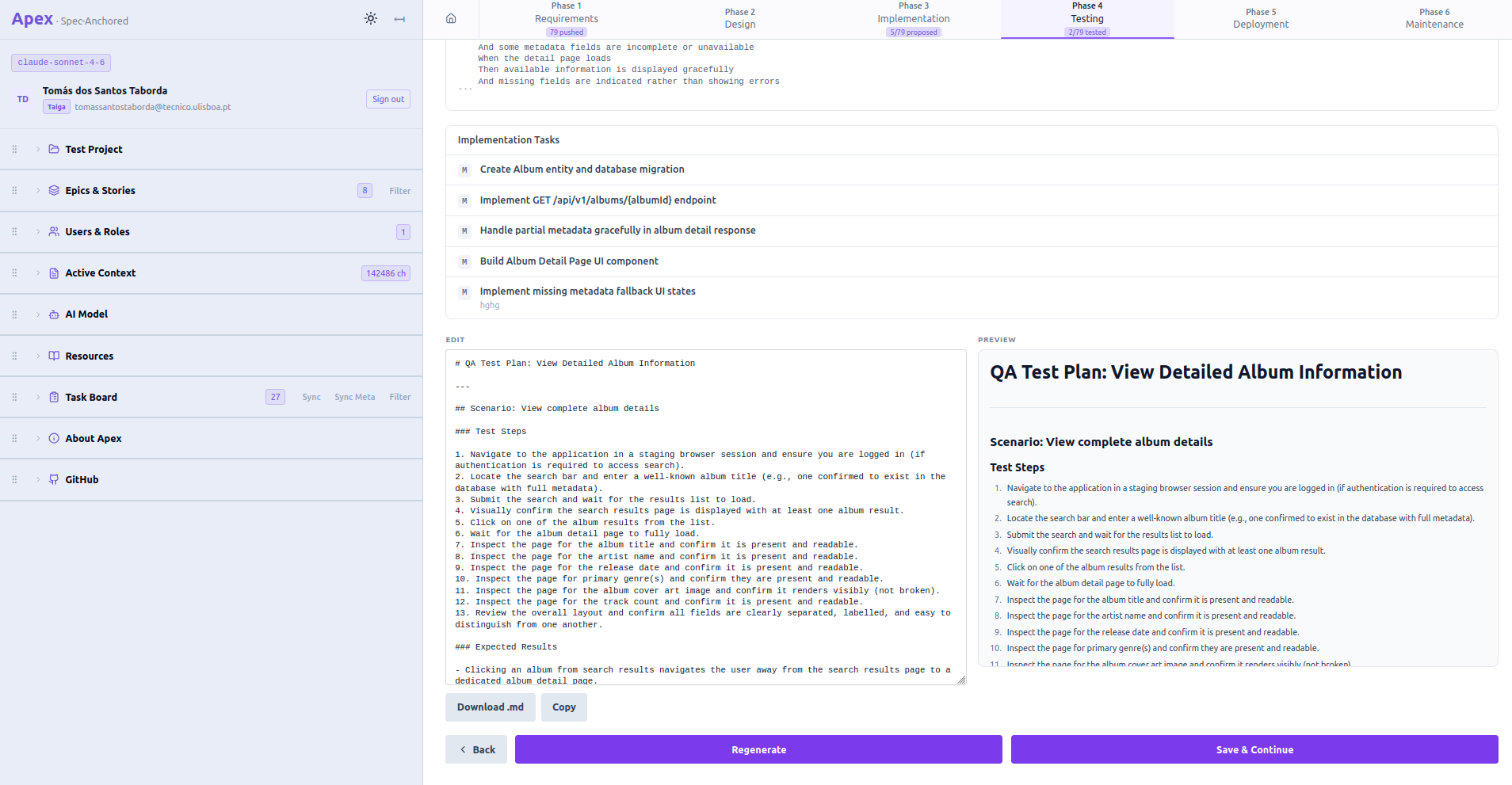
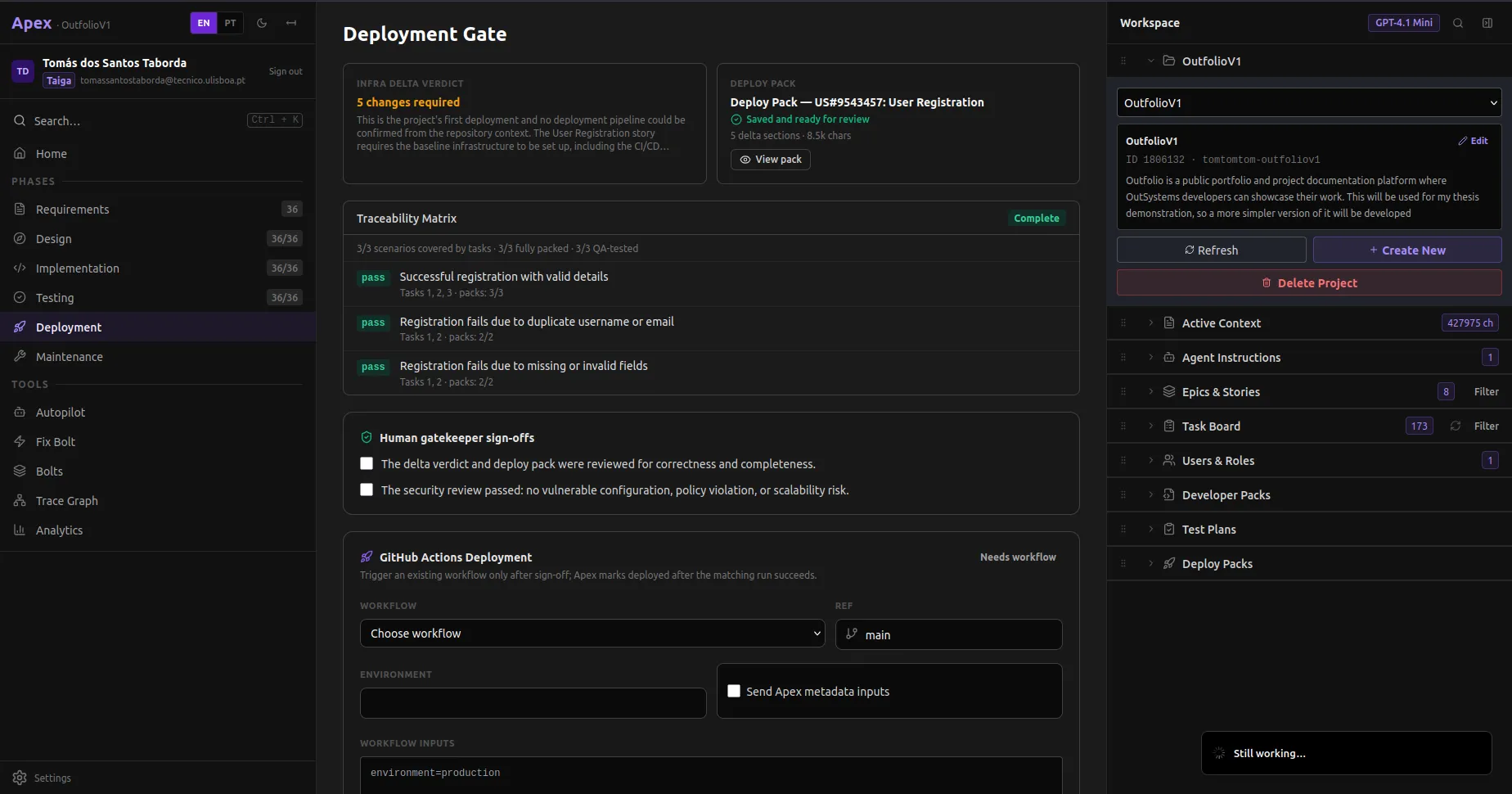
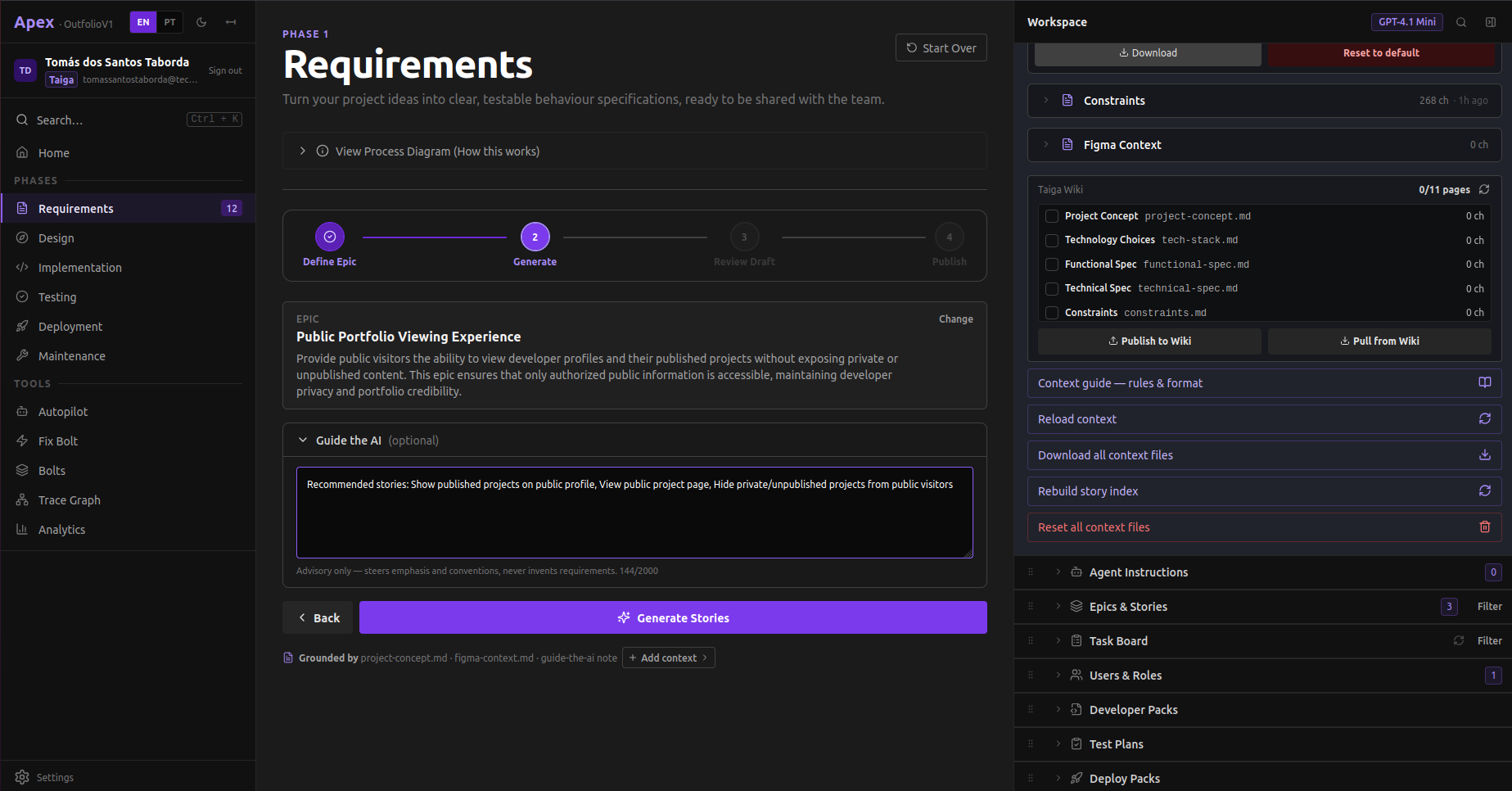
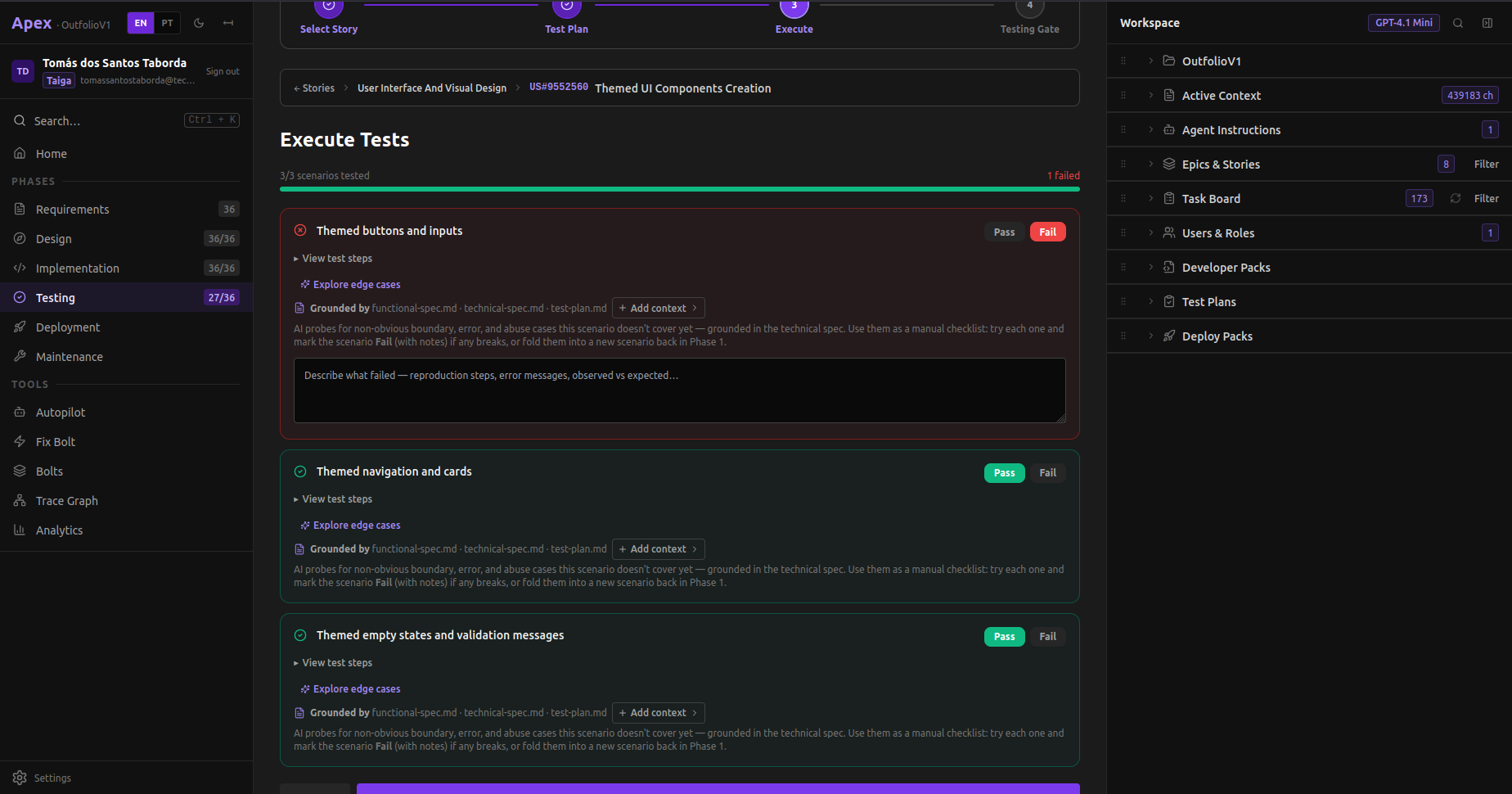
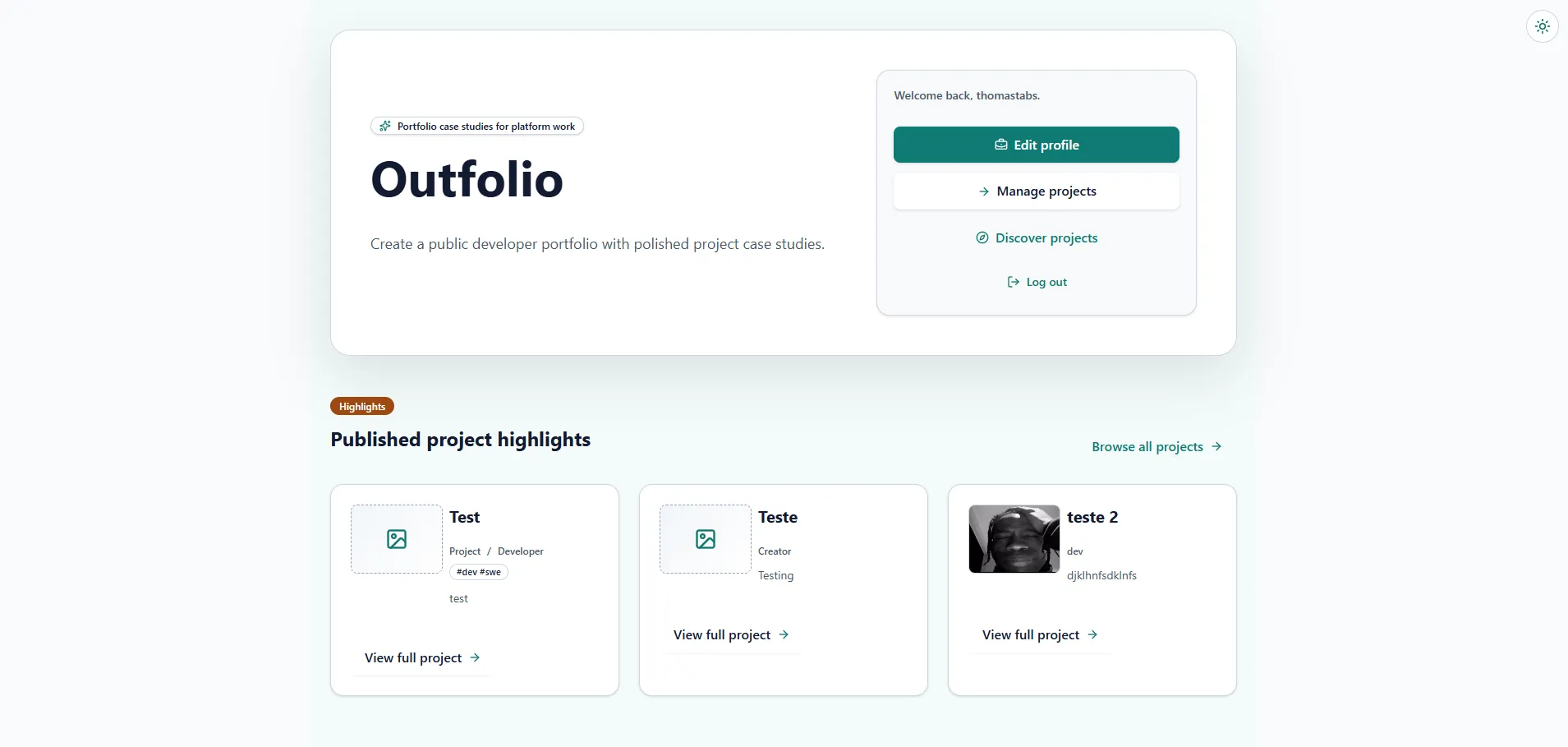
Screens from the dissertation’s demonstration chapter, captured while Apex governed the Outfolio build.
Stack
The framework was carried from Strategic Alignment to a deployed product over nine calendar days, growing from six pre-committed epics to nine epics and 54 stories, none abandoned, with all three loop-back routes exercised more than once.
| Measure | Result |
|---|---|
| Governance constructs realised | 10 of 12 as specified, 1 as a named proxy, 1 partially |
| Task-based sessions | 13 |
| Perceived workload (Raw NASA-TLX) | 21.5 / 100 (low) |
| Perceived usability (SUS) | 56.73, grade D (below published norm) |
| Design criteria (5, fixed in advance) | 2 met, 3 partially met, 0 not met |
| Demonstration (Outfolio) | 9 days, 9 epics, 54 stories, CTR 92.6%, Spec conformance 98.65%, AI defect escape 1.85% |
Across thirteen sessions, perceived workload was low (Raw NASA-TLX 21.5/100) while usability sat below the published corpus mean (SUS 56.73, grade D). Most of the difficulty came at first contact with a dense interface: a practitioner who already knows where they are finds it undemanding, and the tool does too little to get newcomers to that point.
The Outfolio demonstration surfaced a Testing Gate passable by a suite that had stopped measuring the system it tested.
An independent partner organisation was pursued and abandoned: a mid-project migration from Taiga to Plane delayed it while Apex’s adapter was built, and outreach afterwards never led to a scheduled engagement. The framework has still not been run by a team that did not design it.
The app and the dissertation share one git history across six months, so the way the work was built can be read back out of it: when the stack changed, when the thesis started pulling commits away from the app, and which bugs were only found by writing about the tool.
bolt, a Streamlit app
Turned an epic into Taiga work with Claude, keeping approved requirements in local Markdown. One Python process, four phase views.
Reflex rewrite
Renamed Apex on 7 May, then moved to Reflex for a home dashboard and tabbed phase navigation.
FastAPI + Next.js split
The Reflex monolith was replaced by a FastAPI backend and a Next.js 14 frontend (React Query, Zustand, Tailwind), deployed as two Azure Container Apps.
Governance analytics dashboard
Bolt Cycle Time, Context Traceability Rate and AI Defect Escape Rate, the three metrics Chapter 6 later defines.
Cross-check with a second model
A second model reviews the first model’s output.
Figma integration
Frame-to-story linking, with design changes flagged into Phase 6.
Bring your own API key
OpenAI, Google and Anthropic keys per project.
“The Spec Ledger” design system
PRODUCT.md and DESIGN.md written: a dense, flat interface with one violet accent and mono type for every identifier, then a full UI polish pass against it.
Outfolio chosen as the demonstration project
Same day: per-task Bolt lifecycle tracking.
Full repository audit
Every Critical to Low finding closed within 24 hours.
Dissertation scaffolded
IST template, all ten chapters as \todo stubs.
Plane integration merged
A second PM adapter at Taiga parity, prompted by a partner organisation’s tool migration.
Chapter 6 cut from 28 to 18 pages
The framework chapter’s first real cut.
Demonstration criteria pre-registered
Written down before any fieldwork, to block post-hoc selection.
First evaluation session surfaces two bugs
A GitHub context-pack token ceiling, and stale context still trusted at “High Confidence”.
Evaluation data complete
13 participants against a target of 12; none withdrew.
Diagrams redrawn for the thesis
The June architecture and user-flow diagrams were split and redrawn as the dissertation figures, and the six-phase lifecycle diagram became Figure 6.1.
Fix-Bolt data-loss bug
Bug reports were overwritten instead of appended, caught while writing the chapter that describes Fix-Bolts.
IST compliance audit
71 of 80 pages of main text, 99 of 100 in total.
Bolt Cycle Time missing from the export
The dashboard computed it; the Markdown and CSV exports never included it.
Submitted
Dissertation (99 pages) and extended abstract (8 pages), on the deadline.
Defended, 17/20
Public defence before the examination committee.
Final post-defence version
Role wording made consistent, committee printed on the cover.
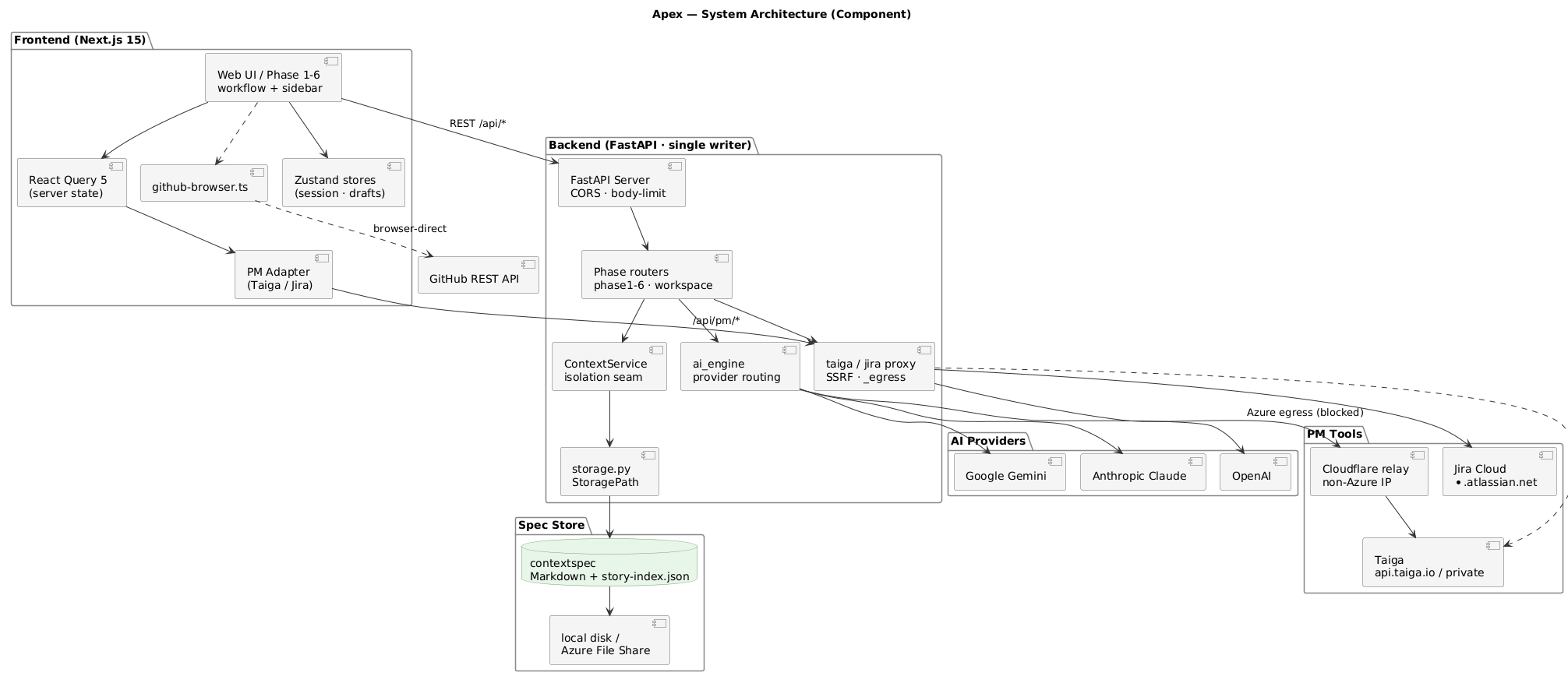
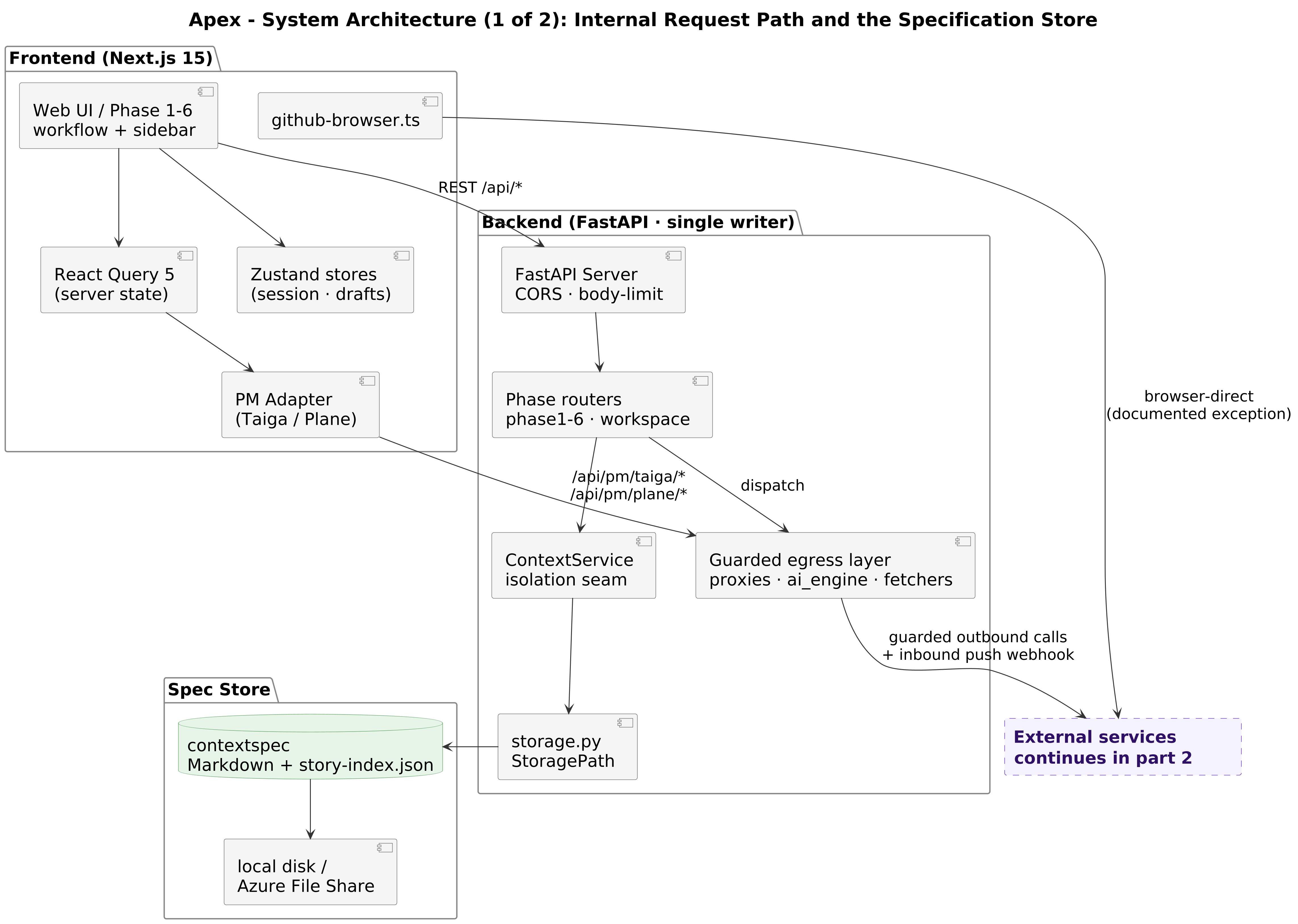
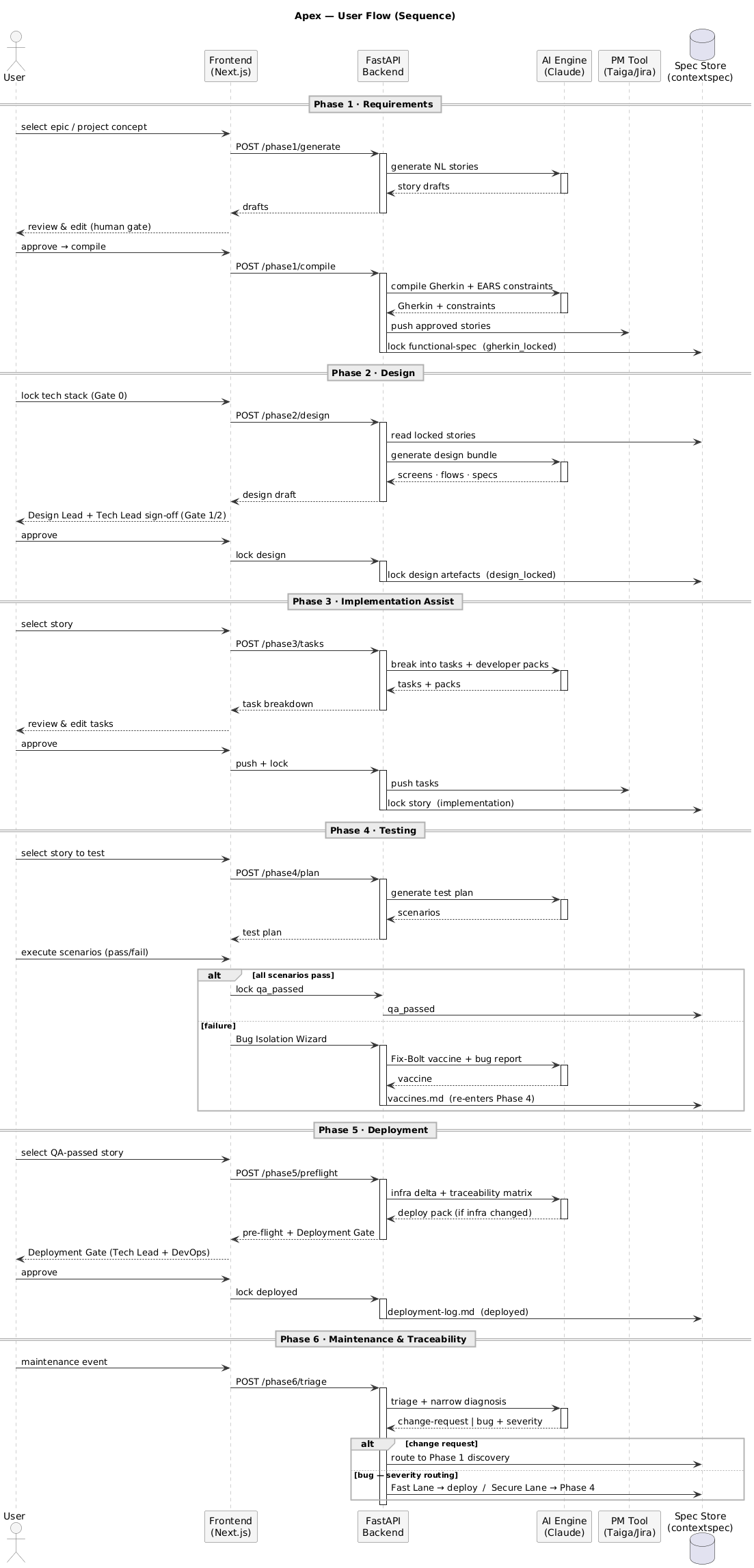
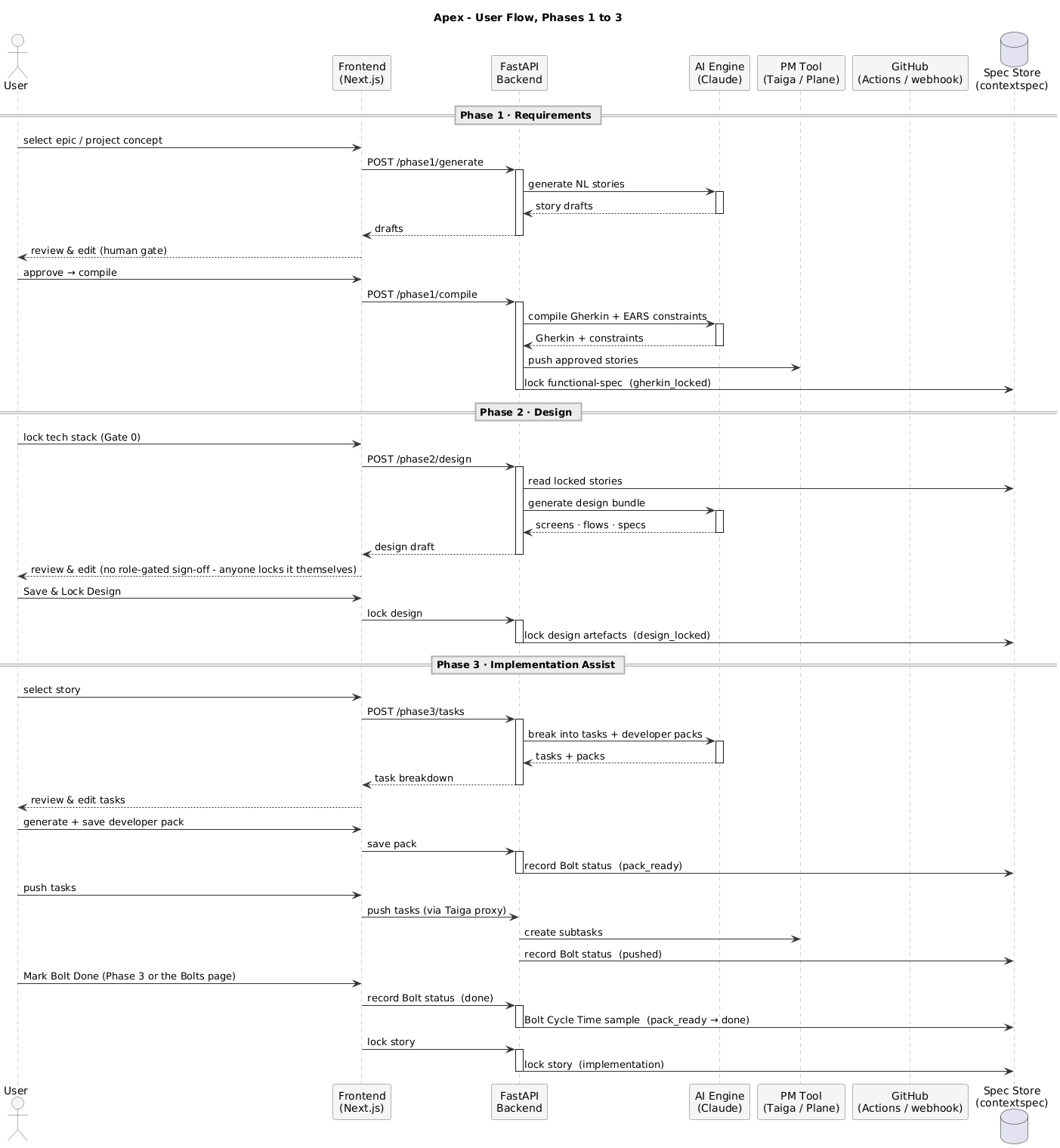
The original dashboard this section draws on: every timeline entry, chapter write dates, page budgets and the backlog close-out.
Open the ledgerOn paper, every construct looked complete. Implementing it found what the text had left unsaid: Bolt Cycle Time was first measured through the wrong proxy and only caught by checking the code against its written definition, and spec-drift detection only worked once I admitted specifications are owned per story, not per project. I now ask "can I implement this?" while reviewing the idea.
The gates did their job structurally: generation alone never satisfied a phase. But the Testing Gate accepted a suite that no longer exercised the current system, and the deployment pre-flight reported high confidence from a stale context file. The next version needs gates that check how fresh their inputs are, and a control for destructive actions inside a phase, which the gate model does not cover today.
Interviewees liked the framework; participants rated Apex grade D (SUS 56.73), and 9 of 13 named density, orientation or navigation as what confused them, not the AI mechanisms. A cluttered screen gets read as a hard method, so first-contact usability, error legibility and visual simplicity belong in the framework’s requirements from the start.
The demonstration recorded 19 Fix-Bolts across 14 stories; the AI Defect Escape proxy saw one. Every instrument I used measured perception, none measured delivered quality, and the only full lifecycle run was me wearing every hat. The thesis says so plainly, and the next steps follow from it: direct production telemetry, a token and compute cost metric per Bolt with a hat that owns it, and an evaluation with independent teams on more than one project-management tool.
@mastersthesis{taborda2026apex,
  author = {Tom{\'a}s dos Santos Taborda},
  title  = {Governed Human-AI Collaboration Across the Software Development Lifecycle: A Process Framework and Its Reference Implementation},
  school = {Instituto Superior T{\'e}cnico, Universidade de Lisboa},
  year   = {2026},
  month  = oct,
  type   = {MSc dissertation},
  url    = {https://tomastaborda.com/work/apex}
}Notes from my MSc defence on 23 October 2026: what was hard, what went well, and what the jury was right to push on.